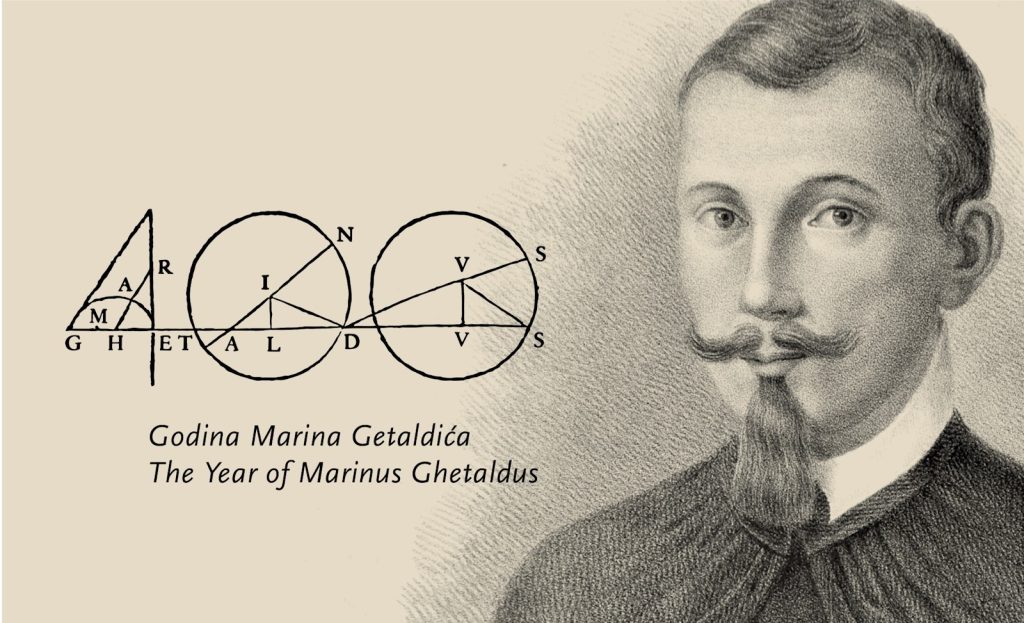
In 2026, the 400th anniversary of the death of Marin Getaldić (1568–1626) will be marked. He was one of the most distinguished Dubrovnik, Croatian, and European scientists at the turn of the 16th to the 17th century. He made an exceptional contribution to the development of mathematics, experimental physics, and modern methodology in the study of natural sciences, exerting a strong influence on the European scientific community of his time.
His six-year journey through Europe’s leading scientific centres, London, Antwerp, Paris, and Padua, enabled him to come into direct contact with the most important scientists of the early modern period, including Galileo Galilei. These encounters and exchanges of ideas decisively shaped his scientific development, encouraging him to apply mathematics as the central tool for understanding nature. Upon returning to Dubrovnik, alongside his successful service in the Republic of Dubrovnik, he systematically carried out experimental and theoretical research, with particular emphasis on work on parabolic mirrors and optical experiments in the “Betina Cave.” The only preserved parabolic mirror made by Getaldić is today kept at the National Maritime Museum in Greenwich, testifying to the international significance of his work.
Getaldić was the first in this region, and among the first in Europe, to apply mathematics as a key instrument for the quantitative description of natural phenomena, laying the foundations of the methodology of modern science, later systematically defined in the works of Galileo Galilei. His work resonated strongly in European intellectual circles of the 17th and 18th centuries, securing him the status of one of the leading scientists in the field of hydrostatics. During his lifetime, he published six works, and in 1630 his daughters posthumously published his final work in Rome, “On the Analytic and Synthetic in Mathematics”.
Taking into account Getaldić’s rich intellectual legacy, as well as the long-standing reception of his research in European science, the marking of the 400th anniversary of Marin Getaldić’s death is an opportunity for the comprehensive affirmation of Dubrovnik’s scientific heritage and its place within the European context. Commemorating this anniversary will encourage not only the study and popularisation of Getaldić’s work, but also a broader understanding of the historical role of the Republic of Dubrovnik in shaping scientific thought in the early modern period.
Through the Programme of Public Needs in Culture for 2026, the City of Dubrovnik has already placed special value on programmes dedicated to Marin Getaldić, ensuring the conditions for cooperation with Dubrovnik’s scientific, cultural, and educational institutions, as well as the public and private sectors. This will make it possible in the coming year to further raise awareness of his contribution and scientific legacy, strengthen the international visibility of Dubrovnik’s scientific and humanistic tradition, encourage science-popularisation projects, and promote Dubrovnik as a city of rich scientific history and contemporary research potential.
Based on all of the above, the City Council of the City of Dubrovnik has declared 2026 the Year of Marin Getaldić.
The Year of Marin Getaldić